The answer — one pick, priced
Get the
GardePro E5S
$30 under your budget
64MP, a 0.1-second trigger and 100 ft of no-glow night vision for $50 — and then it never costs another cent, because nothing transmits.

Fit ledger — need → measured evidence
■ The catch — co-equal billing, always
You have to walk in. No cellular, no app, no alert — you drive out, pull the SD card and leave your scent across the site every time you check it. On a distant property or a pressured bedding area, that intrusion costs you more than a data plan would.
Dealbreaker? Runner-up №1 is cellular for $79, plus $9.99/month ↓
■ Every product has a catch. Verdicts that hide it are how bad buys happen.
Don't buy this if…
- you need a home security camera with continuous recording and cloud storagehome security cameras dossier →
- you want an action camera for personal recording during huntsaction cameras dossier →
- you need a camera primarily for indoor wildlife or bird feeder monitoring
- you want a dashcam for vehicle-mounted recordingdash cams dossier →
Wrong product for you is still a bad buy. These are the cases where we'd send you somewhere else.
Runners-up — if your needs differ


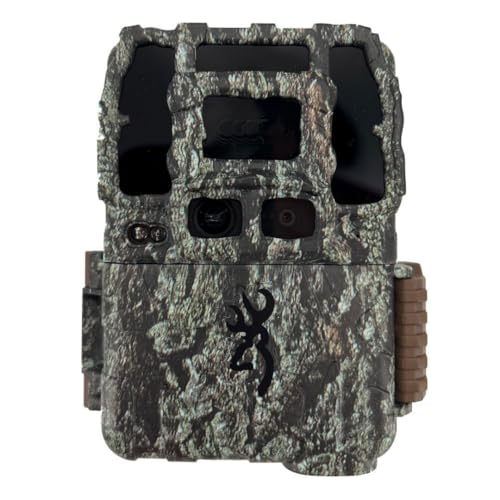
Adjacent verdicts — other needs, same method
Different budget, different household, different job — each of these is already researched, priced and verified. Take the one that matches your need.
Traps — this verdict avoids
Why the GardePro E5S is right for you
It avoids every trap below — and for just me, under $80, it is the pick because it delivers:
The plan is the price
Cellular cameras are cheap hardware sold on a mandatory monthly plan — Tactacam Reveal $5-$13/month, Moultrie Mobile from $9.99/month, Stealth Cam roughly $5-$20/month. A camera quoted at $79 really costs about $199 in its first year. We price hardware plus twelve months of service.
Interpolated megapixels
The 64MP, 46MP and 40MP numbers on the box are interpolated, not optical sensor resolution. Real image quality comes from sensor size, lens and processing — we weight measured detection range and tested night images, not the sticker figure.
Transmitting cameras can be illegal
Several U.S. states restrict trail cameras for hunting, and some ban transmitting/cellular models specifically during defined seasons or on public land — Arizona and Utah are the usual examples. Confirm with your state wildlife agency; a card-based camera sidesteps the transmitting rules entirely.
Provenance — 10 sources, dated
Winners are picked from the full research dossier at knowledgelib.io. Prices, stock and listings are re-verified monthly.