The answer — one pick, priced
Get the
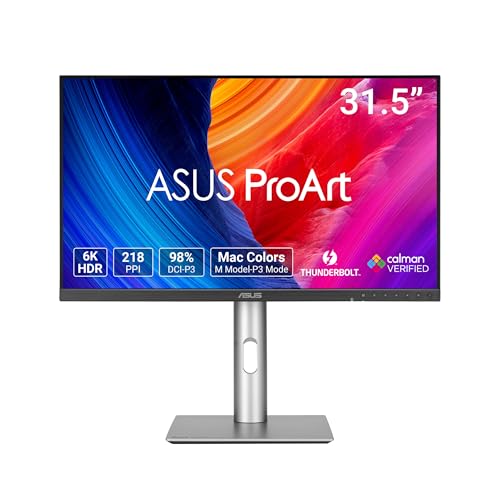
ASUS ProArt PA32QCV 6K
No budget ceiling
RTINGS' top pick for MacBook Pro, Mac Mini and Mac Studio — 8 sources converge: a 32-inch 6K Retina canvas at 218 PPI over Thunderbolt 4, under Apple's price.
Fit ledger — need → measured evidence
■ The catch — co-equal billing, always
It's a bare panel. No webcam, no speakers, no microphone — Apple's built-in Center Stage camera and six-speaker audio are things the ProArt simply doesn't have, so you supply your own. And at 32 inches it eats noticeably more desk than a 27-inch display.
Dealbreaker? Runner-up №1 builds in the camera and speakers ↓
■ Every product has a catch. Verdicts that hide it are how bad buys happen.
Don't buy this if…
- you primarily need a gaming monitor with 144Hz+ refresh rate and low input laggaming monitors 4k dossier →
- you need a budget office monitor under $500 and do not care about Mac-specific featuresmonitors for work under 500 dossier →
Wrong product for you is still a bad buy. These are the cases where we'd send you somewhere else.
Runners-up — if your needs differ


Adjacent verdicts — other needs, same method
Different budget, different household, different job — each of these is already researched, priced and verified. Take the one that matches your need.
Traps — this verdict avoids
Why the ASUS ProArt PA32QCV 6K is right for you
It avoids every trap below — and for anyone, no cap, it is the pick because it delivers:
The 4K softness tax
macOS is sharpest only at native 2× Retina scaling — 5K at 27 inches and 6K at 32 inches both hit 218 PPI, but 4K at 27 inches lands at 163 PPI and forces non-integer scaling that leaves text visibly softer. Buy the resolution your screen size actually needs.
Underpowered USB-C drains the battery
USB-C Power Delivery has to match your Mac — a MacBook Pro 14-inch needs 70W+, the 16-inch needs 96W+, a MacBook Air wants 30–45W. An underpowered monitor drains the battery while it's plugged in instead of charging it.
The Thunderbolt tax
Thunderbolt 4/5 monitors cost $200–600 more than an equivalent USB-C display, and it only pays off if you actually daisy-chain a second display, move 40+ Gbps of data, or dock peripherals over one cable. Most single-monitor desks never use it.
Provenance — 8 sources, dated
Winners are picked from the full research dossier at knowledgelib.io. Prices, stock and listings are re-verified monthly.